
Akhand
Bharat
STRATEGIC
REVIEW OF JANTAR MANTAR PROTESTS
June –
July 2026
“The Jantar Mantar protests represent the complex kaleidoscope
of an aspirational young generation’s dissatisfaction with geriatric political
leadership, democratic realpolitik, and covert external intervention, against
the alluring backdrop of an Akhand Bharat.” – Col RS Sidhu
Backdrop
India in its earlier
avatar of ‘Bharat’ was governed by a hereditary monarchy. In this model
of governance, the society norms flowed from the ruler, as may be averred from
the vernacular paraphrase, “Yatha Raja, Tatha Praja” (As is the King, so
are the people).
Today, India is a
sovereign, socialist, secular, democratic republic, with a multi-ethnic,
multi-cultural, multi-linguistic, and multi-religious civil society. Virtuous
political leadership is the key to maintain balance in such a factitious
political environment.
However, in a democracy,
where the reins of power are beholden to the will of the people, the political
leadership reflects the behavioral norms of the citizens; “Yatha Praja,
Tatha Raja” (As are the people, so is the governance). In the current
pervasive materialism in civil society of India it is utopian to expect
political leadership that is a paragon of virtue.
The fact that nepotism
and hereditary transfer of power is rife in most of the regional and national
political parties, speaks volume of the state of Indian politics, and is the
most telling commentary on the existing society mores.
Thus, it should not
surprise that securing and holding on to the ‘Chair of Governance’ is
the basic article of faith across the political spectrum in the murky world of
Indian politics. All other interests are secondary.
Layout
The subject is
appraised in four parts
Part 1 – The Agitation
Part 2 – Defining National Interest
Part 3 – Geopolitical
Review
Part 4 – The Aftermath
“In a diverse society as is India, divergence and
contrarian views should be cause for celebration as they are a much needed
escape valve for letting off civil society pressures.”
Geriatric Leaders Versus
the Youth
The 23% voters of the 18 – 30 years age profile, form
the largest age group voter block in India. There is no representation of this
block in the Central Government Council of Ministers. The next voting block of 30
– 40 years has a representation of mere 2 Ministers. Today, sixty six percent
of ministers in the Central Government are above 50 years of age, while the median
age of the Prime Ministers has increased to 76 years. The demographic profile
of the state governments, with some aberrations, mirrors the above data.
The above statistics
suffice to highlight the generational difference in the thought process of the
governing leadership and the steadily increasing percentage of the youth in the
country.
A Fallible Examination
System
Indian Express in its
investigative analysis published on 7 June 2026 has documented 45 major examination paper
leaks across India over the past 24 years from 2002 to
2026, without any effective systemic reforms by the authorities. Add to
it another listed 150 odd individual infractions during the same period,
without any effective penalisation of the defaulters, highlights the deep chasm
in the priorities of the political leadership and aspirations of the youth.
The National Eligibility cum Entrance Test (NEET-
UG), is a mandatory pan India examination, for admission to Bachelor of Dental Surgery (BDS) and
Bachelor of Medicine and Bachelor of Surgery (MBBS) programs. It is conducted
annually by the National Testing Agency (NTA), and on average more than 22
lakh candidates undertake this examination. The examination has been
surrounded by several controversies since its inception, but the magnitude of
the breach in 2026 led to its cancellation.
This followed in quick succession to the
controversy surrounding the CBSE Board examination 2026, which was
undertaken by over 17 lakh candidates.
Jantar Mantar Ground Agitation July 2026
The 50 days agitation, from 6 June to 25 July
2026, led by the Cockroach Janta Party (CJP) ‘youth’ at the Jantar
Mantar, New Delhi against the NEET- UG paper leak forced the government on the
backfoot. It led to the resignation of the Union Education Minister, and mass
sacking of high officials of the NTA.
The most impactful development has been the
swift passing of the Public
Examinations (Prevention of Unfair Means) Amendment Bill, 2026 by the
Parliament. The Bill seeks to amend the Public
Examinations (Prevention of Unfair Means) Act, 2024, to prevent unfair means in
public examinations conducted by specified public examination authorities, (i)
Union Public Service Commission, (ii) Staff Selection Commission, (iii) Railway
Recruitment Boards, (iv) Institute of Banking Personnel Selection, (v) National
Testing Agency, (vi) Ministries of the central government and their attached
offices, and (vii) other authorities notified by the central government.
Part 2 – Defining National Interest
The Theory
In India, the informed debate on model
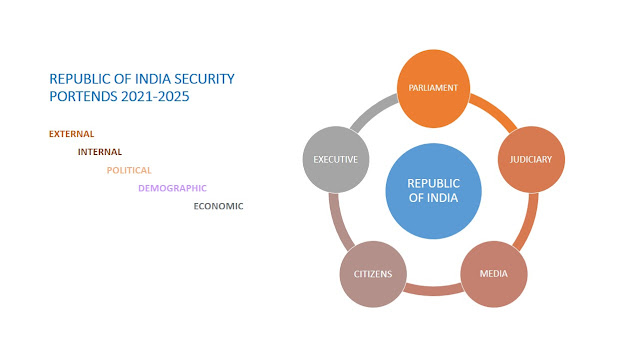
governance is premised on the ‘four pillars of democracy’ the Executive,
Parliament, Judiciary, and the Media. It further revolves around the
doctrine of ‘separation of power’ and the system of ‘checks and
balances’, enshrined in the constitution, between the Executive, the
Parliament, and the Judiciary.
The greatest residual power, in any democracy,
rests with its citizens on whom the ultimate sovereignty is vested. Therefore, it
is incongruent that the role of the citizenry; referred to in the
Constitution as “We the people of India…”; is left out of this informed
debate. An informed citizenry has the inherent potential to be the biggest
strength of a democratic country.
In a democracy, the State ‘personifies the Will’ of its People (citizen) as ‘codified’ in the Constitution; the Executive
is just the ‘Government of the day’, bounded to discharge only
‘stated
responsibilities for a quantified duration of time’; the Legislature is the highest voice of the ‘diverse interest
groups within the People’; and the Judiciary is the final ‘arbiter of the
will’ of the people as coded in the Constitution.
Hence, it may be fair to state that in a
democracy with a written constitution, as is India, the ‘Nation’ combines the
sum total of interests representing the State, the Executive, the Legislature,
the Judiciary, and the People (citizen).
Hence, national interest should be one that maintains balance within
the various subcomponents that collectively form the democratic nation of
India, ensures the unity and integrity of the
nation, assures dignity of the individual, while promoting national environment conducive to enterprise.
The Reality
But the reality is more
complex. There is a conflict of interests between the State, a ‘non person’ permanent entity, and its sub-component entities that form part of
the Nation, where the ‘in persona’ presence of the latter entities is frequently changing.
The injudicious use of the
coercive powers of the State vested with the Executive, periodic overreach
by the Legislature and Judiciary, non-conformity by sections of
the People to the ‘rule of law’, are symptoms of nonequilibrium in the
body politic of India, that get further exacerbated by regional, ethnic,
cultural, linguistic, and religious diversities.
The observation, “Not
all civil protests are in interest of the State, as not all actions or
inactions of the Executive are in interest of the State”, is reflective of
this malady, and best realised by the happenings of the year 2020, wherein the Republic
of India was witness to unprecedented onslaughts across all verticals of its
sovereign pillars, the Legislature, Executive, Judiciary and the informal
Fourth Estate, the Media.
The threats extended from external armed ingress, Galwan
2020, impinging the territorial integrity of the country; large scale civil
society agitations attempting to coerce the Government of the day to repeal ‘Farm
laws’ legally passed by the Parliament; ‘Covid 19’ national pandemic
leading to economic slowdown deeply impacting the State and its Citizens alike;
attempts to influence the Supreme Judiciary through insinuations amounting to
willful contempt; and emergence of partisan news coverage by media divided
along politico-ideological lines, and of even greater concern, breaching public
trust by manipulating TRP ratings.
It is but natural that in
the circumstances national interests get subsumed by parochial and political
pursuits.
What Defines
National Interest!
The Nation progresses best when there is a state of
near equilibrium between its various subcomponents. However, it is not always
so, especially when there is a deep political divide within the body politic.
Ideally, ‘promoting national environment
conducive to enterprise’, covers the full spectrum of national interest. It
entails maintaining internal harmony, judicious equilibrium between the
subcomponents of the Nation, developing ‘Comprehensive National Power’
that affirms national integrity, and secure access to foreign trade and
commerce.
Who Defines National Interest!
The strategic thought leaders do influence the
environment. But the decision ultimately rests in the political domain. Seeing
the complexities of power in a democratic society, especially one as
heterogeneous as India, the defining of ‘national interest’ is best adopted
through consensus approach. This is a political responsibility.
But it is also a reality that for the
political class, the primacy shall always be to retain hold on the reins of
political power. To hold on to the reins of power, participation in periodic
elections is an imperative, and this entails ready access to money bags.
Hence, ultimately, the articulation of short
term national interest shall always be beholden to the money bags who fund
the political campaigns. The greater the political vulnerability, greater shall
be the hold of behind the curtain power brokers and financiers, on the levers
of political power.
Political stability achieved by clear
public mandate in elections is, therefore, the only panacea to ensure that
articulation of long term national interest is in synch with the ‘will
of the people’; for the greatest residual power in any democracy rests with its
citizens, on whom the ultimate sovereignty is vested.
Part 3 – Geopolitical Review
“In contentious times, analysing deeds and
recognising patterns in key events is a surer way for an observer to timely
deduce the likely turn of events.”
‘Operation
Sindoor’ of May 2025 has been the most transformational event in the
geopolitical interface of India with its enemies, ‘frenemies’, and the
fractured comity of nations in India’s near abroad and the Indian Ocean Region
(IOR).
By successfully calling the Pakistan nuclear bluff, Indian political leadership shed its
inhibition to engage in hard strikes against the former, and crafted a new sub-nuclear escalatory
deterrence matrix.
Even more important, India proactively changed
the traditional diplomatic rules of engagement by unilaterally suspending the
Indus Water Treaty (IWT) with Pakistan as a punitive measure.
It prematurely exposed the extent of Chinese
and Turkish military support to Pakistan, leading to review of India’s security
environment. This has given India valuable time
to rearm and restructure its armed forces, ramp up its defensive and economic
infrastructure, and build trusted geopolitical alliances.
The unreliability of an alliance with US in
crunch situation was re-emphasised. This validated the earlier Indian
diplomatic stance of distancing itself from US attempts to transform the
informal QUAD grouping into a military alliance against China.
Overall, India’s success in Operation Sindoor brings to it a bag of
mixed geopolitical fruits. It has enhanced its status as a reckonable entity in
the IOR, opening the door to bilateral security and economic engagements with
the littoral states of the IOR.
However, this very success has also begotten negative attention from
established extra regional powers, as a serious emerging competitor on the
global stage. India shall have to adapt its strategic thought process for
action on a broader canvas to break through the constricting geopolitical
chains being orchestrated by inimical countries to tie it down in South Asian
sub-continent.
The most recent announcement of a ‘Mecca Joint
Defence Agreement’ between Saudi Arabia, Turkiye and Pakistan signed at the
holiest Muslim seat of Mecca has to be viewed not only from the geopolitical
fallout of the ongoing US-Israel conflict with Iran in the Gulf, but also from
the military and diplomatic support to Pakistan by China, Turkiye, Saudi Arabia
and the US during Operation Sindoor of May 2025.
Despite the diplomatic obfuscation, the
alliance is primarily aimed against Iran and its proxies in the Levant region.
This alliance, with behind the scenes support by the US, has been under
discussion for almost last two years, and as such should not surprise the
countries impacted by it. Owing to China’s chokehold over Pakistan security
environment, it is logical to deduce that it has the tacit concurrence of
China, as it eases its stressed energy supply lines.
The countries needing to be wary of it are
Iran, India, Russia, and to certain extent Israel. Iran stands isolated from
its supporting militia spread in the Levant, with the powerful military
presence of Turkiye on its northwestern borders, and Pakistan to its southeast.
A strong Pakistan military contingent is already deployed in Saudi Arabia to
its west.
For Israel it’s a mixed bag. While the
likelihood of direct confrontation between the Mecca Alliance troops and Iran
is remote, it has strong potential to cut off physical support of Iran with its
beleaguered militias, Hezbollah in Lebanon, and Houthis in Yemen, while deterring
the Iran aligned Shia militias in Iraq from any offensive rocket strikes. However,
even when strongly backed by the US, Israel shall be at unease at the marrying
of battle hardened military manpower of nuclear armed Pakistan, with technological
prowess of Turkiye, and the financial clout of Saudi Arabia. It impacts
Israel’s status as a numero uno military power in the Levant.
For Russia, engaged to its east with NATO
backed Ukraine, a strong and friendly Iran added depth to its soft southern
underbelly. With Iran being isolated, the impact is both military and economic
vulnerability, as it forecloses its International
North–South Transport Corridor (INSTC), a 7,200-km long multi-mode
network of ship, rail, road freight route between Iran, Central Asia,
Russia, and Europe.
India’s biggest
concern shall be access of Pakistan to modern military technology from Turkiye,
in addition to Chinese military support. The best option for India is to
strengthen its engagement with Iran, to retain access to Afghanistan and materially
support its confrontation with Pakistan. It should further strengthen its
strategic relationship with Israel, Russia, and UAE and reach strategic
understanding with Greece and Cyprus in Türkiye’s near abroad.
Part 4 – The Aftermath
“For ‘Akhand Bharat’ to come into being it has to be conceived
as a multicultural, multiracial, multiethnic, multi religious entity centred on
the landmass of the Indian subcontinent and the adjoining seas, exercising
global influence.”
Learnings from the Unrest
The defining factor is that an educated
electorate is critical for promoting national interest.
A fair and reliable examination system is the
foremost duty of the state towards its youth, as it is the litmus test of moral
standards in a society.
Hence, the need for urgency in transforming
the country’s fractured education system, including overhaul of national
examination system.
Objective Analysis
There is no denying the fact that the conduct
of the agitators was highly objectionable.
There is substantial evidentiary trail of covert
involvement of foreign government and front organisations in influencing the
agitation.
But this has been the stance of the Government
against earlier agitations too, such as the Farmers agitation of 2020, wherein
the Government succumbed to repeal the three Farm Sector Acts 2020, laws duly
passed by the Parliament of India by majority vote. That was certainly not
in the national interest.
In
this instance the movement forced the hand of the government of the day to
institute sweeping reforms in the national examinations system. If implemented
effectively, it shall be the biggest gift of the government, towards a more
aware citizenry and greater probity in society.
It is also most pertinent to record that the
Indian leadership has a lot to thank it’s adversaries for covertly
orchestrating the Jantar Mantar agitation. Just as
during the initial stages of Galwan incident of 2020, it forced the
government’s hand in undertaking strategic course correction in the right
direction! Apparently, the
dynamism of the leadership comes to the fore when faced with an adverse
situation.
Future Stance
The negative forces being sequentially
activated on various fronts internally within India, and that operating from beyond
its borders, have a single point focus, to disrupt the rise of an ‘Akhand
Bharat’. This ‘third rising’, even in its infancy is generating
energies powerful enough to seed disquiet and unease in the ranks of its
internal and external adversaries. This is when no political or nationalist
force has openly espoused this goal. Externally, a powerful India adversely
impacts the interests of the established great powers. Internally, it sounds
the death knell of the hereditary politico-business empires.
There is a strong inevitability of increasing
degree of internal strife, preceding the rise of India. But there is a caveat;
the internal strife has to be firmly contested and not merely wait patiently for
it to fizzle out. This is a time of dissonance and disruption for the Indian
body polity; greater the delay, deeper shall be the disruption. The optimum,
rather the only way out is to enhance the resonance within, by a public clarion
call to rally around the ideology of an ‘Akhand Bharat’.
There shall be adverse consequences, ab
initio, in following this path. But they shall be outweighed by the internal
consolidation that it shall orchestrate. To radiate outwards, needs a strong internal
musculature. It shall generate dynamic ‘shaktis’ (energies) that shall
break open the ‘chakravyuh’ (tactical trap) of its adversaries.
Once the nation aligns itself to the vision of
an ‘Akhand Bharat’, it shall impart clarity of purpose to the country as
a whole as never before. ‘Akhand Bharat’ shall then be the touchstone
against which the governance fabric of the country needs to be rebuilt.
Some immediate internal reformative measures that the Government needs to pro-actively
initiate to release pent up energies are briefly enumerated below.
Induct youth leaders in positions of power; a low hanging fruit,
but a double edged sword if not executed judiciously.
Revitalise the lower administrative, revenue,
police, and judicial machinery
of the state, which impacts overwhelming percentage of its citizens, by
clearing deadwood. This shall be the most difficult to undertake, but shall
transform the society in the shortest possible timeframe.
Introduce compulsory military history syllabus
in schools across all central and state
education board governed schools. This shall exponentially support the primary
vision of instituting ‘Agniveer’ entry scheme into the armed forces.
Rethink the impending military theatre command
restructuring to support the
vision of ‘Akhand Bharat’. What is being proposed is too little, too
late, and tantamount to a cosmetic change, that shall merely add another
hierarchical layer of command.
All the above measures are interlinked and should not be weighed one against the
other for prioritising.

Comments
Post a Comment