
US ISRAEL ATTACK ON IRAN – PART II
THE BATTLE OF NERVES AND NARRATIVE
“If a battle gets prolonged against a determined adversary adept at waging
asymmetric warfare, then the decision matrix gradually shifts from the domain
of qualitative and quantitative technological prowess to the arena of battle of
nerves and the ‘power of narrative’.” – Col RS Sidhu
Backdrop
The battlefields of Vietnam of the
1960s, Afghanistan of the 1980s and again in the first two decades of 21st
century, are standing testimony to the decisive role of ‘nerve of the
leadership’ and the ‘power of narrative’ in asymmetrical conflict. The
former is decisive in inducing the leadership succumbing to ‘battle fatigue’,
while the ‘power of narrative’ renders the adversary ‘hors de
combat’ by striking at the roots of the support base.
Early Comparatives of the Wars in Rus
and the Levant
The Russians opened their ‘Special
Military Operation’ (SMO) in Ukraine, with a military strike by their special forces to seize the airfields of
Kiev, capital city of Ukraine, and Kharkiv to stun the Ukraine government
and military into surrender within ten days. The failure of the coup de main mission is already
prolonging the war into its fifth year.
The US and Israel too opened their
attacks against Iran by launching a decapitating strike against Iranian political
and military hierarchy on 28 February 2026 to force capitulation by Iran
within seven days. But despite achieving spectacular success, they failed
to achieve the anticipated unconditional surrender by Iran.
Iran disrupted the US – Israel
strategy by taking recourse to asymmetric warfare and decentralise the executive
authority to launch offensive missile strikes on pre-determined geostrategic
and economic targets in the entire region of Levant and beyond. By innovative
employment of their surface launched autonomous weapon systems, Iran has
succeeded in widening the conflict zone from the Arabian Sea to the Mediterranean
Sea, thereby, shifting the centre of gravity of the conflict theatre away
from their mainland into the maritime zone. Here it’s interesting to note,
that the two powerful carrier strike groups of the US Navy have already been
forced to temporarily pull away from the restricted maritime conflict zone into
safer open ocean waters.
Russian failure to correctly assess the combat potential of
Ukraine armed forces, launching
the SMO with comparatively inferior ‘boot strength’ employing approximately
100,000 troops against 250,000 Ukraine Army, and
intelligence support to Ukraine by NATO were at the root of the Russian military
failure to accomplish the military mission in a swift timeframe.
US – Israel too have erred in their initial assessment of Iran
combat potential, launching the offensive with no recourse to ‘boot strength’,
and not anticipating impact of Iranian access to Russian and Chinese
intelligence support.
Quite the like the Russian SMO, the
US – Israel combine too is being forced into recalibration of their war
strategy to impose their will over Iranian leadership.
‘Battle of Nerves’
The conflict is inexorably morphing
into a ‘battle of attrition’, where it shall be the ‘nerve of the
leadership’ that shall be a decisive factor. More the conflict prolongs,
greater shall be the negatives for the protagonists for the involved nations,
and personally for their respective leaderships. This is where the ‘nerve of
leadership’ shall be decisive.
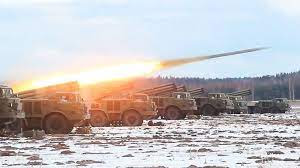
Iran’s strength lies in its arsenal
of surface launched autonomous weapon systems, and its capability to
deny navigation of the critical Straits of Hormuz. US – Israel rule the
skies and the maritime waters off Iran, effectively cutting it off from
external material support. Iran’s energy trade, the lifeline of its economy, is
under siege. Cut off from external material support, economic collapse of Iran
is a matter of time.
The US – Israel core strength lies in
their domination of Iranian airspace and maritime waters. However, their vulnerability
is their relative weakness in combating the Iranian swarm employment of its
surface launched autonomous weapon systems. Additionally, the lacunae
of ‘boot strength’ is washing away all the gains of qualitative and quantitative
technological superiority. A prolonged conflict makes the economics of war
prohibitive for US – Israel, their regional allies, as well as the
countries dependent on the Gulf for their energy supplies.
The personal survival of the
leadership of the protagonist countries is also at stake, dependent on the
outcome of the ‘short and sharp’ conflict. Under the circumstances, whose
leadership nerve gives way first will be the decisive factor.
Midway Course Correction
The US – Israel are feverishly
reworking their war strategy by embodying asymmetrical allies into their war
effort. Towards this end, they are attempting to induce the Kurdish rebel
minorities in the Northeast of mountainous Iran, and the Baluch rebels in
the relatively open Southeast of Iran to join the battle. What role the Pakistan
military is coerced into by the US in this course correction is as yet ambiguous.
How far this strategy succeeds in influencing the outcome is uncertain, as one
of the unintended consequences of employing this strategy could lead to an
obverse outcome of deepening Iranian support for the government in power.
The most demonstrative lesson emerging
from this conflict is the relative ineffectiveness of the anti-missile defense radars
and interceptor systems to provide safe coverage from modern hypersonic weapon
platforms. Though the US and Israel rule the Iranian airspace, they have been unable
to successfully defend their key vulnerable areas from Iranian hypersonic
weapons. In this respect the relative effectiveness of the Indian air defence network
against Pakistan drone swarms and surface launched autonomous weapon systems during
‘Operation Sindoor’ is notable, unless of course it is ascribed to well-known Pakistan
military incompetencies.

Excellent narrative
ReplyDeleteThank you Gopal Dewan
DeletePen is mightier than sword, arms and armaments are number one industry in the world, psychologically have we evolved, we are destined to create suffering as the intellect and knowledge have proven to be counterproductive, devoid of any wisdom, war iis the best occupation.
ReplyDeleteThank you Sushil, wars have been, are, and shall be part of human civilisation!
DeleteSharp observations on how modern conflicts shift from quick strikes to wars of endurance and narrative. The comparison with Ukraine highlights the risks of underestimating an adversary’s asymmetric capabilities. Thought-provoking analysis indeed.
ReplyDeleteThanks dear Rakesh
Thank you Rajive
Delete